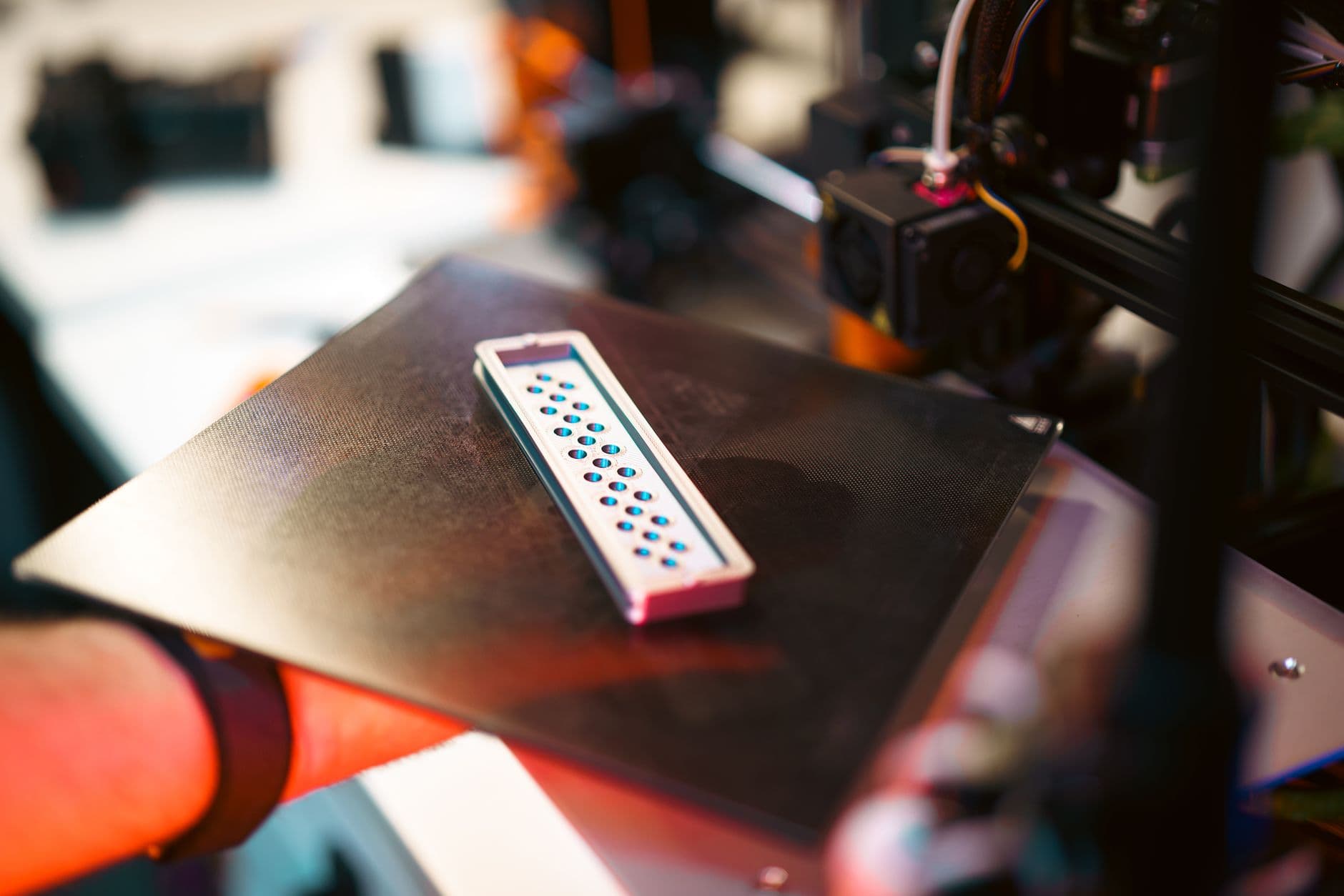
Rapid prototyping is the ability to turn a CAD file into a physical part in hours or days instead of weeks. It's built on the simple idea that you learn more from holding something than from looking at a screen. The goal isn't to create a perfect final product on the first try, it's to iterate quickly and cheaply until your design actually works.
Most rapid prototyping uses 3D printing (additive manufacturing), though sometimes it includes casting or light machining. What matters is that the cycle time between "I have an idea" and "I can test it" collapses from months to days.
Why the speed matters
The real value isn't just speed for its own sake. When you can print a new iteration in a day instead of waiting two weeks for a machined sample, you stop thinking about prototyping as a separate phase. Instead it becomes part of your normal design process. You try something, see how it fits your hand, how the threads engage, whether the wall thickness flexes too much. Then you adjust the model and print again.
This matters because problems that look fine on a screen often surprise you in your hands. A wall thickness that looked reasonable reveals itself as weak when you apply actual force. A draft angle that seemed steep turns out to be too shallow. A button position feels wrong even though the dimensions are correct. You catch these issues before committing to expensive tooling for mass production.
The prototyping spectrum
Rapid prototyping happens at different fidelities depending on where you are in the product lifecycle.
Early on, you might print a rough proof-of-concept just to validate the overall shape or confirm that an assembly idea works. This doesn't need to be polished or match your final material properties. A quick resin or FDM print is enough to show stakeholders what you're thinking about and move the conversation forward.
As you move further into development, you shift toward functional prototypes. These need to behave like the final product will behave. If your design will be injection molded plastic, you want to test a printed version made from a material with similar strength, flexibility, and temperature resistance so you can actually verify performance. If dimensional accuracy matters for fit or assembly, you need to hit those tolerances in your prototype too.
Later in the cycle, some companies use printed prototypes for limited market testing or pilot runs. At this stage you're printing dozens of units to put in customer hands before you invest in tooling for full production.
When you actually need it
Rapid prototyping isn't necessary for every product. If you're designing something simple with clear requirements and you're confident in your assumptions, you might skip straight to production tooling. That's rare though.
You need rapid prototyping when there's uncertainty about how your design will perform in the real world, or when the cost of getting it wrong in production is high. If you're developing medical devices or aerospace components, you can't afford to discover fit or assembly problems after you've committed millions to tooling. You iterate on a prototype first, test it, validate it, then move to production.
You also need it when you're working in a fast-moving market and speed to launch matters. Printing multiple design iterations and testing them in weeks instead of months gives you a real competitive advantage. You can respond to customer feedback, incorporate learnings from testing, and get to market with a better product.
It's valuable for complex assemblies where you need to understand how parts fit together and interact. An exploded view in CAD doesn't tell you what happens when tolerances stack up across multiple components. A printed assembly often reveals issues that 2D drawings wouldn't catch.
It's also useful when you're trying to communicate a design to manufacturers, retailers, investors, or customers. A physical prototype is immediately convincing in a way that a 3D render isn't. It answers questions without requiring lengthy explanation.
The practical trade-off
Rapid prototyping works well because it trades off perfect fidelity for speed and cost. Your printed prototype won't exactly match your final production part. The surface finish might be different. The material properties won't be identical. Tolerances might be looser. This is fine because you're not trying to predict production quality. You're trying to learn whether your design concept is sound and whether the product will actually work.
Where this breaks down is if you skip learning. Some teams print a prototype, look at it briefly, nod, and move to production tooling. That defeats the purpose. The value comes from actively testing the prototype, measuring performance, catching problems, iterating, and testing again.
The speed also means iteration is affordable. You can print ten versions in the time it would take to machine one. This removes the pressure to get it right on the first try and frees up thinking. Instead of agonizing over a design decision in the CAD model, you can print both versions and see which one works better.